WaterClear-GS: Optical-Aware Gaussian Splatting for Underwater Reconstruction and Restoration

Xinrui Zhang, Yufeng Wang, Zesheng Wang, Dacheng Qi, Wenrui Ding, Shuangkang Fang
Beihang University
Curaçao
J.G. Red Sea
Thistlegorm

WaterClear-GS delivers high-quality underwater reconstruction and restoration at real-time speed.

160+ FPS Real-time rendering
Physics-informed Optical Gaussian attributes
Dual-branch Underwater + clear appearance
NVS + UIR Unified reconstruction & restoration

Abstract

Underwater 3D reconstruction and appearance restoration remain challenging due to the complex optical properties of water, such as wavelength-dependent attenuation and scattering. Existing Neural Radiance Fields (NeRF)-based approaches often suffer from slow rendering and limited practicality, while vanilla 3D Gaussian Splatting (3DGS) lacks an effective mechanism to account for underwater degradation.

To address this, we propose WaterClear-GS, a physics-informed reformulation of underwater Gaussian splatting that models degradation as intrinsic Gaussian attributes rather than external medium fields. Furthermore, we adopt a dual-branch optimization strategy that preserves underwater photometric consistency while encouraging a practical separation between restoration-oriented latent clean appearance and degradation. This strategy is enhanced by depth-guided geometry regularization and perception-driven image supervision, together with exposure constraints, spatially adaptive regularization, and physics-informed spectral regularization, which collectively promote spatial coherence and plausible visual appearance.

Extensive experiments on standard benchmarks and our collected dataset demonstrate that WaterClear-GS achieves strong performance on both novel view synthesis (NVS) and underwater image restoration (UIR) tasks, while maintaining 160+ FPS real-time rendering.
Method

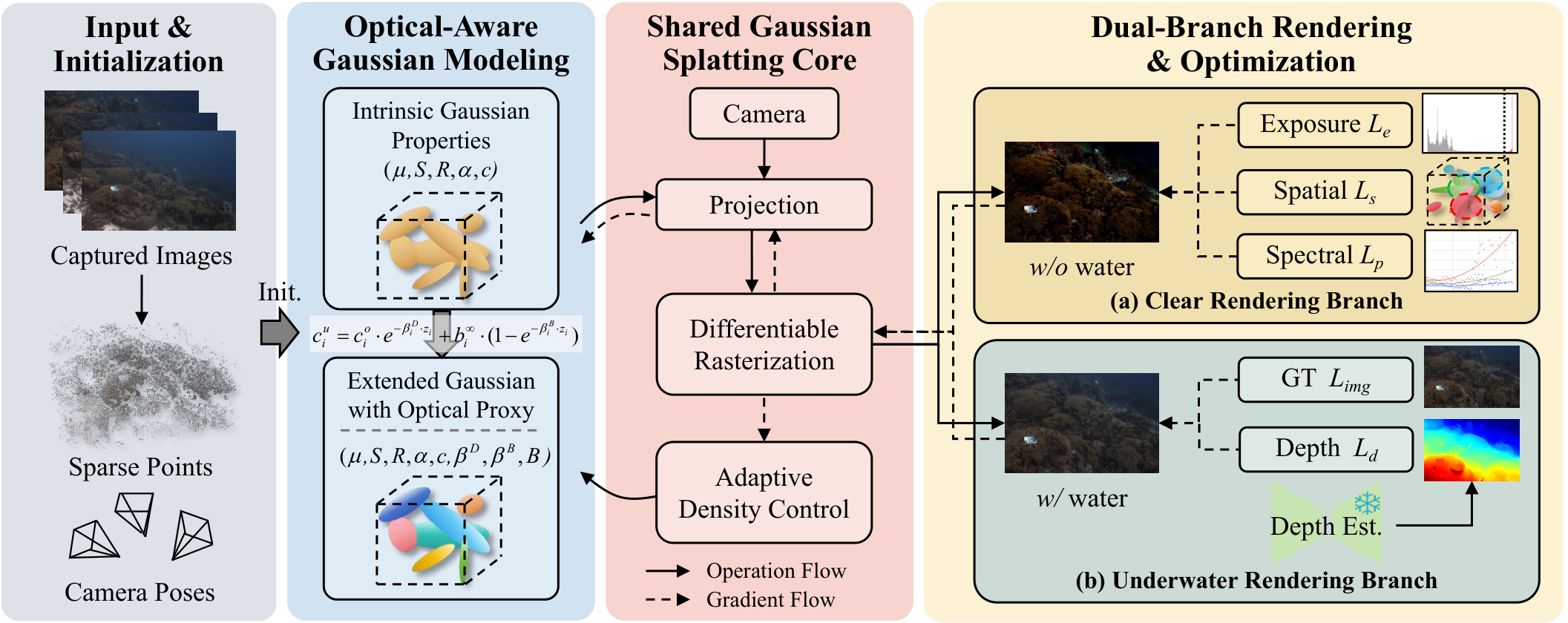
Our method augments each Gaussian with wavelength-aware optical proxy parameters for attenuation, backscatter, and veiling light. A shared Gaussian splatting core supports dual-branch rendering: (a) the underwater branch fits the input observations, and (b) the clear branch learns a restoration-oriented latent clean appearance. Depth-guided supervision stabilizes geometry, and exposure, spatial, and spectral regularizations further improve restoration quality.

Pipeline of WaterClear-GS

Figure. Pipeline of WaterClear-GS.

NVS Results

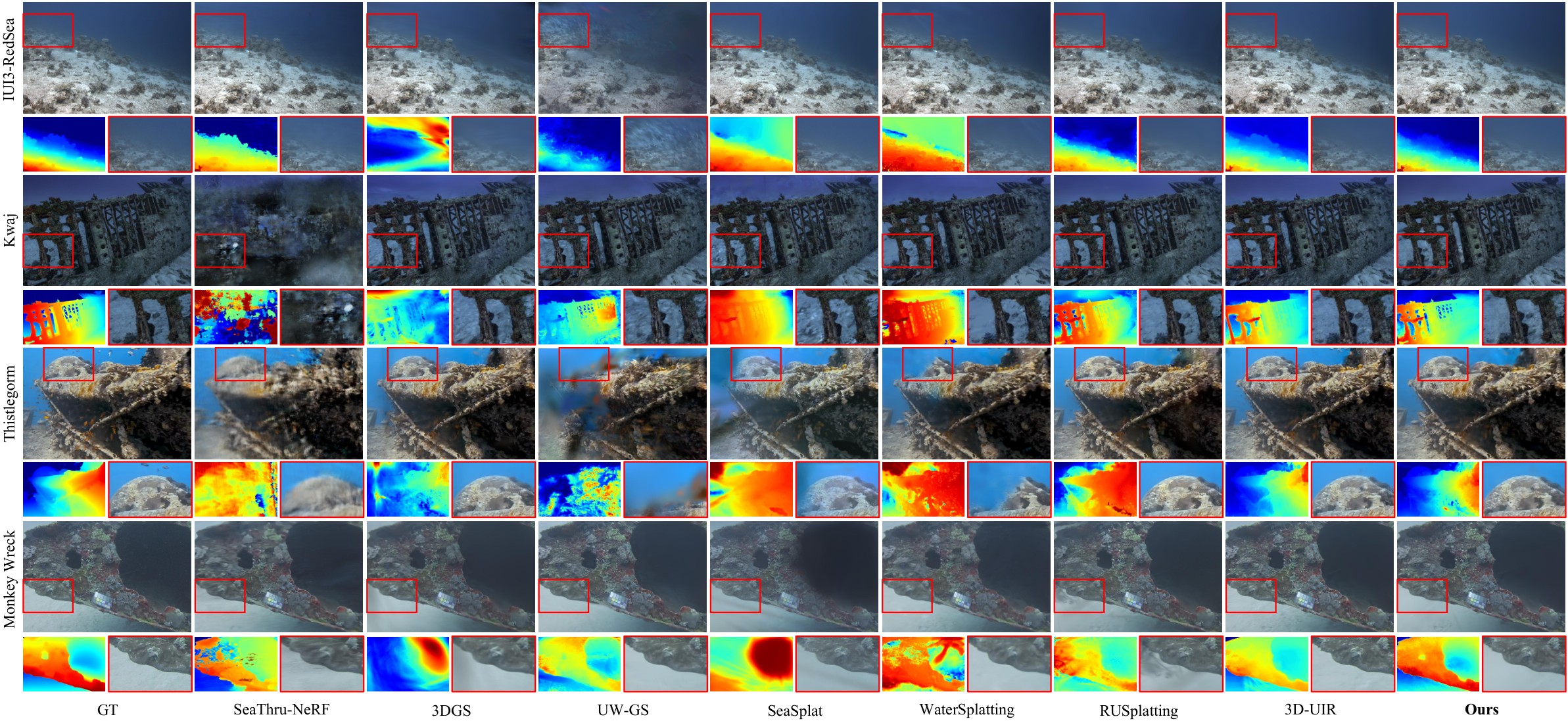
Qualitative NVS comparisons on IUI3-RedSea, Thistlegorm, Kwaj, and Monkey Wreck

Qualitative novel view synthesis on IUI3-RedSea, Thistlegorm, Kwaj, and Monkey Wreck. Each result shows the rendered view, a depth map, and a zoomed crop. WaterClear-GS recovers sharper geometry and more faithful appearance than competing NeRF- and 3DGS-based methods.

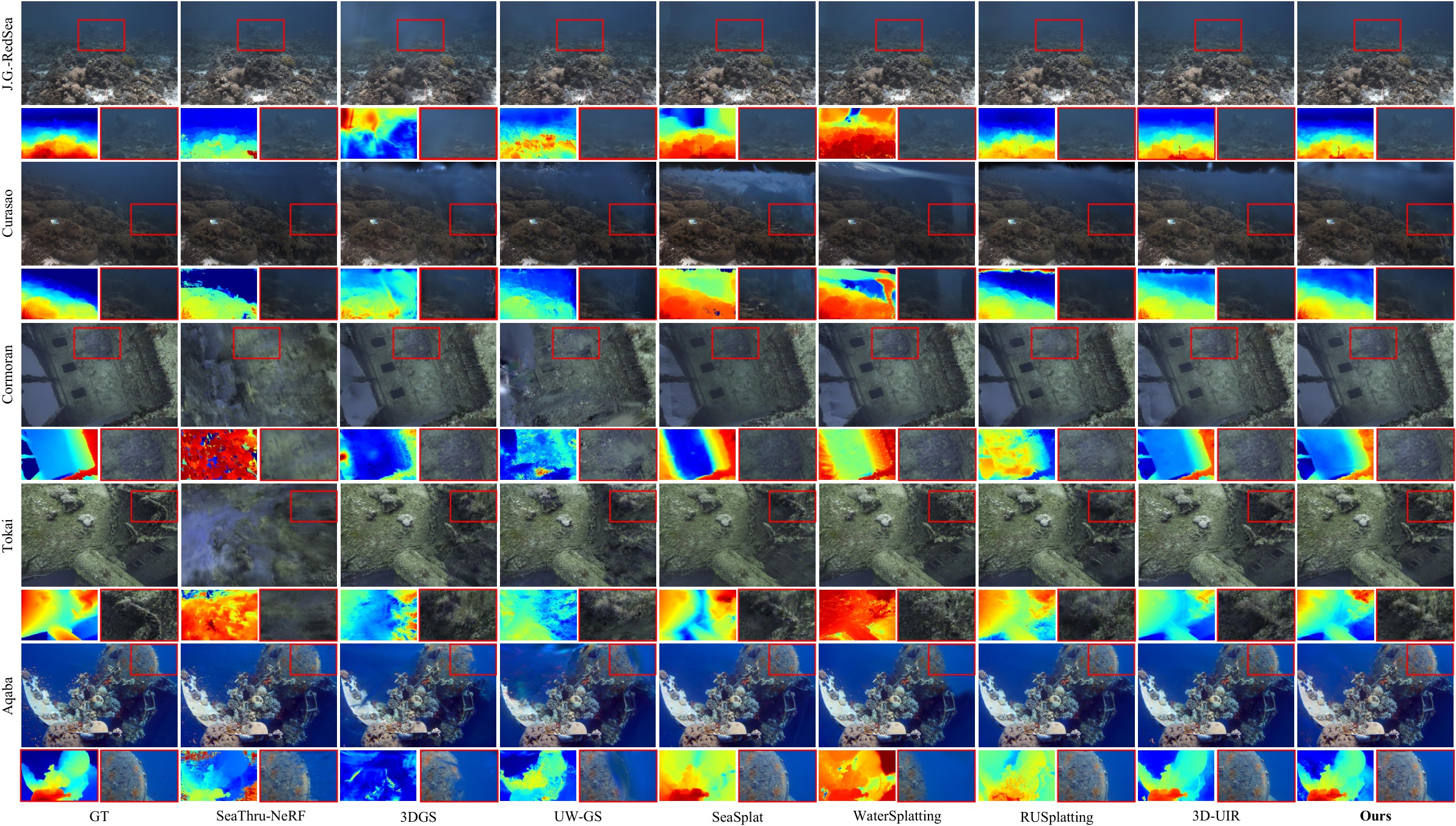
Additional NVS comparisons on J.G.-RedSea, Curaçao, Cormoran, Tokai, and Aqaba

Additional NVS comparisons on J.G.-RedSea, Curaçao, Cormoran, Tokai, and Aqaba.

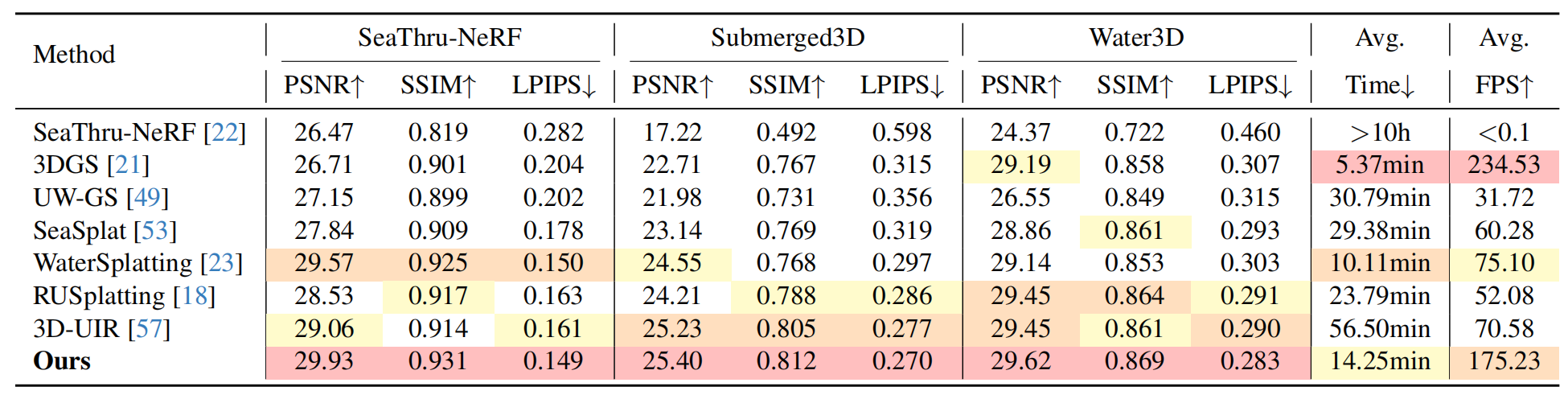
Quantitative NVS comparison table

Quantitative NVS comparison on SeaThru-NeRF, Submerged3D, and Water3D. WaterClear-GS attains strong reconstruction quality while remaining real-time, with 175+ FPS on average.

UIR Results

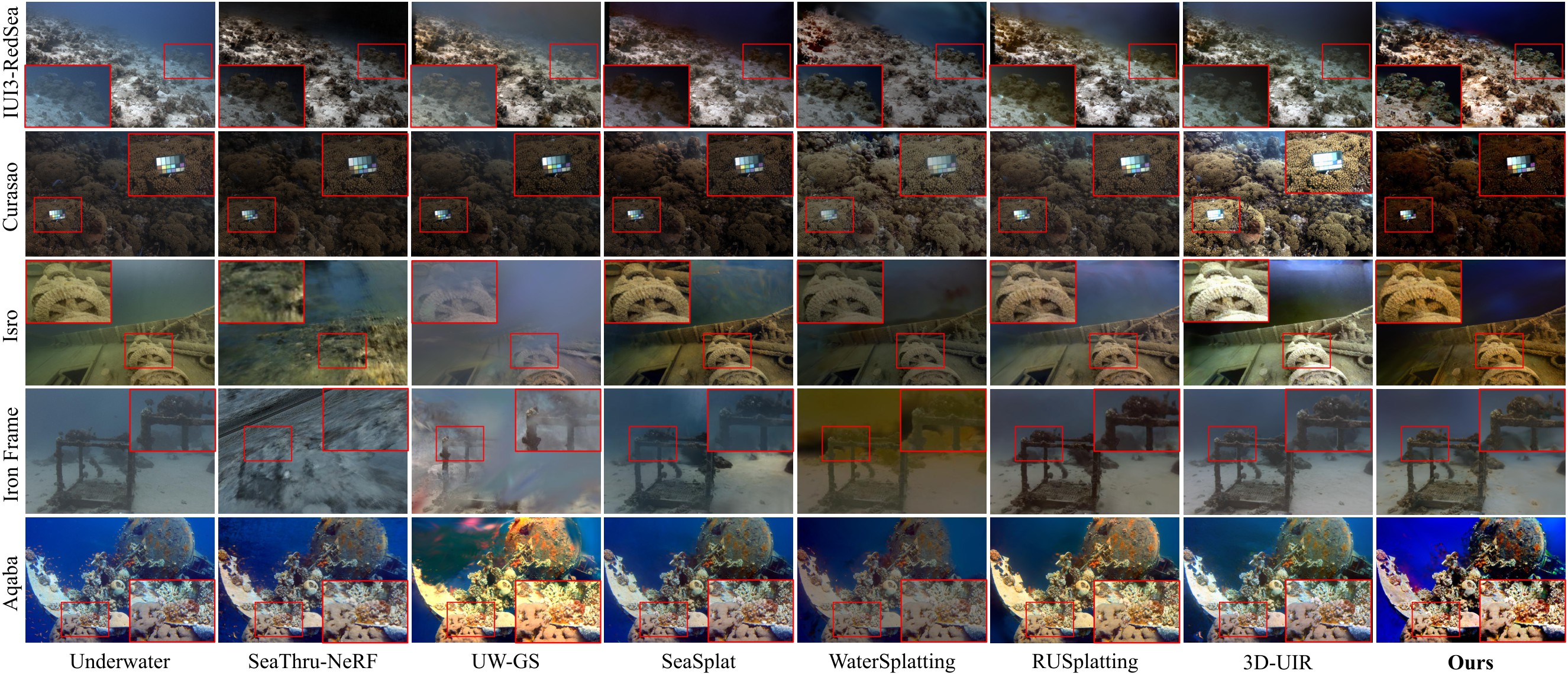
Qualitative UIR comparisons on Curaçao, Isro, Aqaba, Iron Frame, and IUI3-RedSea

Qualitative underwater image restoration on Curaçao, Isro, Aqaba, Iron Frame, and IUI3-RedSea. WaterClear-GS removes scattering more cleanly and restores more natural colors and textures.

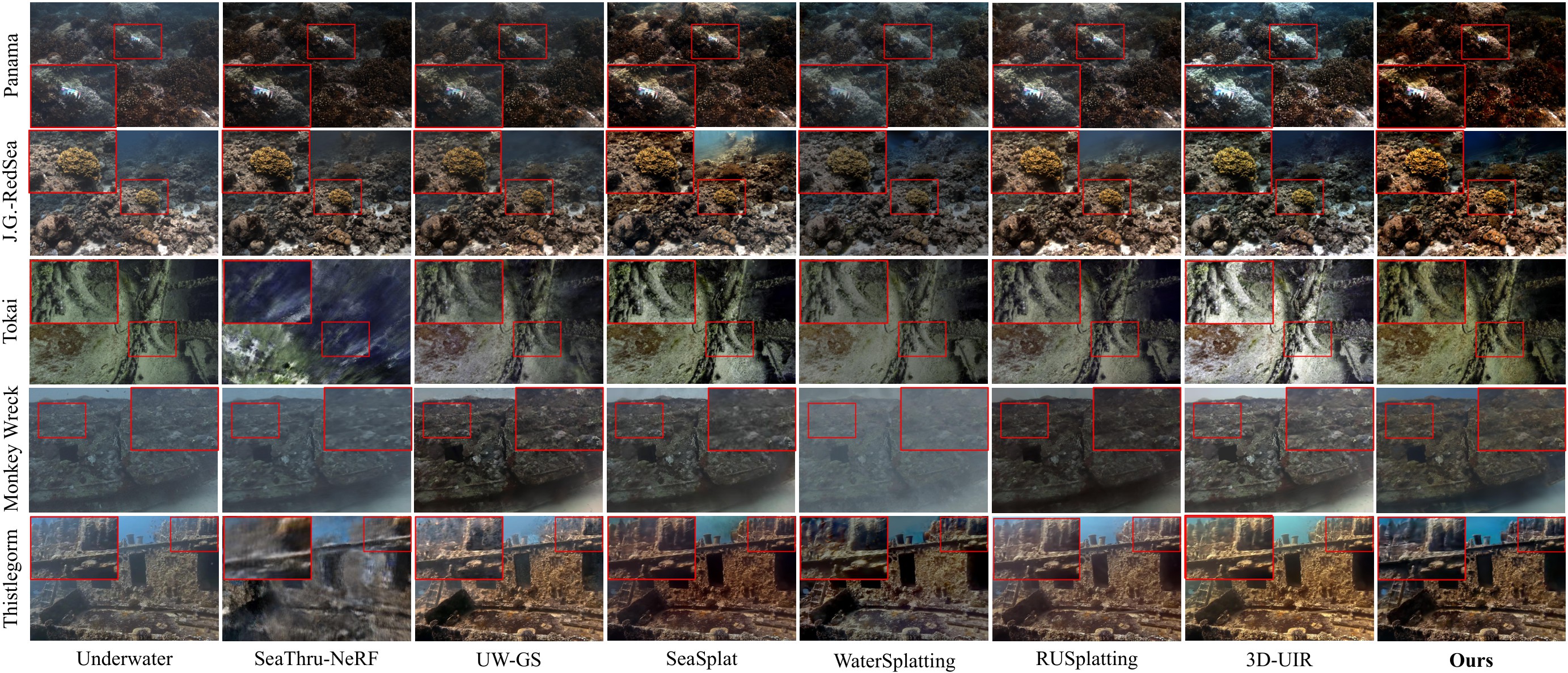
Additional UIR comparisons on Tokai, Thistlegorm, Panama, J.G.-RedSea, and Monkey Wreck

Additional UIR comparisons on Panama, J.G.-RedSea, Tokai, Monkey Wreck, and Thistlegorm.

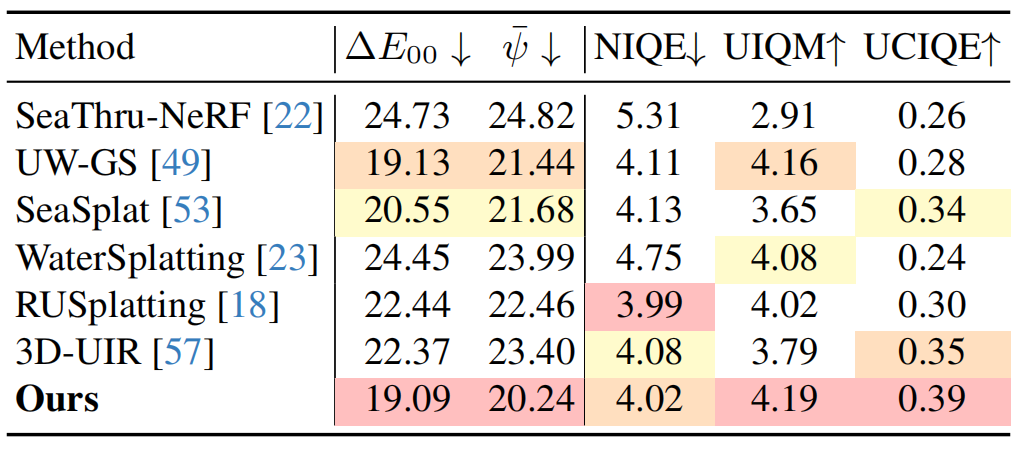
Quantitative UIR comparison table

Quantitative UIR comparison. WaterClear-GS ranks first on most restoration metrics, including color difference, underwater image quality, and colorfulness.

BibTeX

@article{zhang2026watercleargs,
  title   = {WaterClear-GS: Optical-Aware Gaussian Splatting for Underwater Reconstruction and Restoration},
  author  = {Zhang, Xinrui and Wang, Yufeng and Fang, Shuangkang and Wang, Zesheng and Qi, Dacheng and Ding, Wenrui},
  journal = {arXiv preprint arXiv:2601.19753},
  year    = {2026}
}